Showing posts with label Anodizing. Show all posts

New Blog Post: Beginner’s guide to coloring processes for anodized aluminum


Life is full of options - and anodizing coloring is full of options, too!


There are 4 different coloring processes you can choose:

1. Adsorption/Dying
2. Electrolytic
3. Integral
4. Interference

But which is the right one for your anodized aluminum product?

Find out in my latest blog post: https://aluconsult.com/beginners-guide-to-coloring-processes-for-anodized-aluminum/ 

8 things you should ask your anodizer about

In my 25 years as a consultant in the anodizing industry, I realized that about 70 % of my consulting clients were not anodizers but the people who had to “deal with” anodizers. Perhaps you have had also frustrating experience ordering anodized parts and not receive what you wanted?

You might think that your anodizer was just not good at their job. Or that anodizers will always try to keep their costs as low as possible and thereby sacrificing the quality of your aluminum product. But that does not do the problem justice. In my experience, the main reason for errors and frustrations is ineffective communication. Yip, just like in any relationship, the relation to your anodizer will improve tremendously by learning how to communicate better.

8 important things to agree on with your anodizer

To make your next phone call with your anodizer much more successful, here is a checklist with all the aspects of the anodizing process you should talk about.

  1. Agree on the properties and quality of the anodizing results. 
  1. Choose the right alloy to achieve the properties you want. 
  1. Identify the microstructure of your different aluminum parts as this will affect the surface look. 
  1. Agree on handling and racking of the aluminum parts as part of the preparation. 
  1. Decide together on the right pretreatments for the specific parts of your aluminum product. 
  1. Set specifications for the anodizing process as these parameters affect the properties. 
  1. Choose the most environmentally friendly sealing 
  1. Agree on quality control tests that fit the properties of your anodized product. 

This checklist is a good start to improve the communication with your anodizer and to receive the correct anodized parts. If you would like step up your game even more and become more confident in asking the right questions, join my new live online training: “Working with your anodizing supplier.”  

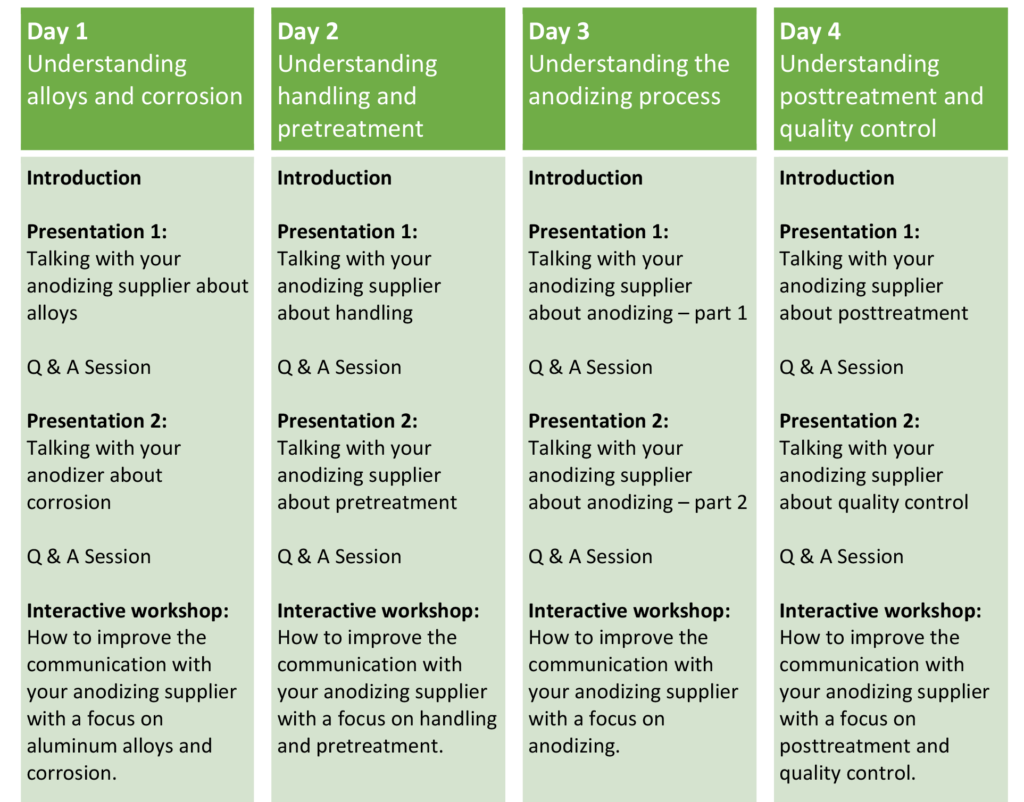
Working with your anodizer - course overview graph

The course consists of four workshops, each treating an independent subject. You can also attend single workshop days. This interactive live online event is held on Zoom in 4 x 2,5 hours sessions. We will record the presentation and make them available to you after the workshop. The dates of our next courses are:


WORKSHOP SERIES IN APRIL: 7, 14, 21, and 28 April 2021 (03.00 - 5.30 PM CEST)  


WORKSHOP SERIES IN MAY: 5, 12, 19, and 26 May 2021 (03.00 - 5.30 PM CEST) 


Looking forward to seeing you at AnodizingSchool!

Sunny regards, 

Anne Deacon Juhl 

P.S. If you would like to learn some anodizing basics, have a look at this blog post in which I give an easy to understand introduction.


________________________________________________________________________________

Influence of temperature on Voltage response when Anodizing


A question from a customer:

We have investigated the influence of the electrolyte temperature in our anodizing tank - Anodizing at a low and a warm temperature, current controlled and in our standard anodizing electrolyte.

The voltage at the higher temperature runs with a lower value than the voltage with the lower temperature and at the same time the voltage stays constant for the duration of the anodizing process. 

At the lower temperature the voltage keeps rising until we turn of the power. 

Do you have an explanation of why the voltage at the higher temperature stays constant, although the layer thickness is identical with both temperatures (with identical current settings and anodising time)?


Answer:

Higher temperature in the anodizing electrolyte leads to higher conductivity, which means lower voltage for same current and time.

So your Vhigh temp is lower than your Vlow temp


Then Ohms law gives you             V = R x I


Vhigh temp = Rhigh temp x I

 Vlow temp = Rlow temp x I


I = same for the two temperatures


The total resistance of the electrical circuit consists of several resistances:


High temp:


Rhigh temp = Relec, high temp + Rthickness, high temp + …..


Low temp:


Rlow temp = Relec, low temp + Rthickness, high temp + …..


Lower temperature gives lower conductivity, so Relec, low temp ˃ Relec, high temp which is the reason for a higher Vlow temp

Higher temperature of the electrolyte will lead to faster chemical attack of the formed aluminum oxide changing the structure of the formed oxide and the resistance Rthickness, high temp

This will lead to an equilibrium thickness, where formation rate of oxide = dissolution rate of oxide leading to a constant voltage.

Lower temperature of the electrolyte will lead to a higher V0, low temp than V0, high temp for same current I.

The coating weight of the oxide layer is higher when formed at lower temperature - more compact and by this Rthickness, low temp will be higher than Rthickness, high temp. 

This is the reason for a continues increase in Vlow temp during the process time but eventually you should see a steady voltage here too.


If you are curious and want to know more about temperature, voltage and other parameters when anodizing in sulfuric acid you should sign up for the first and only online anodizing course!


Introduction to Anodizing - Click here!


If you find this article useful and you would like to know more please contact me 
 
__________________________________________________

Spangle on etch aluminum EN AW 6063


The spangle effect on the aluminum EN AW 6063 alloy has been known for many years.

There are still a lot of unanswered questions but more recently explanations have thrown light on some of the issues. 

The spangling effect on aluminum can be divided into three categories: grainy, galvanizing and sparkling.

The type where the grains are visible by the naked eye after etching is called grainy. Galvanizing is used when only few of the grains are shiny, and the sparkling is when the whole surface is shiny.

The first picture shows a EN AW 6063 aluminum alloy directly from extrusion - not a very beautiful appearance and with a lot of die lines - looking closer you can maybe see some of the grainy structure already. 


The next picture shows the surface after etching and anodizing. Here a very grainy structure is seen leaving to a very unattractive surface - especially if it should fit together with areas which are not having this surface appearance.


If you as a designer want to create something special - this could be a very interesting surface appearance to work with.

Well, back to the subject - why do we see this spangle effect on anodized aluminum.

There are two reason to look for - the first one is the content of zinc (Zn) in the etching tank and the second is the content of Zn in the aluminum alloy.

The grainy appearance is caused by the chemical composition, whereas the two more shiny appearance are due to the content of Zn in the solution and grain orientation.

The orientation of the grains has an influence on how much they are etched in the alkaline solution. Zinc is more noble than aluminum so in the alkaline solution there will be a selective dissolution of aluminum. This will lead to a higher concentration of Zn in the grains with a certain orientation creating small galvanic elements from grain to grain.

If at the same time there is zinc in the alkaline solution, even as little as 5 ppm can cause spangle under the right conditions.

Addition of a small amount of sodium sulphide can be used to precipitate the zinc decreasing the spangling effect of the aluminum alloy.

The EN AW 6063 itself should not contain more than 0.03% zinc.

If you want to know a lot more about anodizing and defects

Please sign up for more information regarding the first and only online anodizing course - Introduction to Anodizing presented by the Anodizing School.


If you find this article useful and you would like to know more, please contact me 
__________________________________________________

Recycling as a hot topic at the Aluminium - World Trade Fair and Conference in Dusseldorf


9 years ago I wrote the first post about The good and the bad about recycled aluminium. Since then recycled aluminium has become a hot topic and this year´s Aluminium - World Trade Fair in Dusseldorf - Aluminium 2018 has dedicated a lot of energy into this subject.

One of the articles in their news room is about recycled aluminium,

RECYCLING: CHALLENGES FOR ALUMINIUM AS AN INDUSTRIAL MATERIAL

A short informative note about challenges, mentioning that there are no qualitative differences between aluminium alloys made from the primary and those made from recycled aluminium.

Is this always true - not really, especially when looking at the result obtained when anodizing aluminium.

Here you have to be aware of the following:

  • Heavy metals
  • Metallurgical structure
  • Traceability
  • Repeatability/Consistency
  • Consistent recycled stock

So it should not be difficult to use more recycled aluminum for anodizing. It only requires a minimum amount of adjustment to arrive at the present alloy composition, which works well for anodizing. So this should not be the reason for not using recycled aluminum when anodizing.

From an environmental viewpoint, anodizing is a very unique process. It does not require the use of organic solvents, which may cause unwanted atmospheric emissions and the amount of sludge can be diminished by using new processes as the acid etch.

Finally anodized extrusions and castings can be readily recycled without the need for special emission control equipment, so no VOC or other hazardous chemicals are emitted to the air.


If you find this article useful and you would like to know more please contact me blog@aluconsult.com 
__________________________________________________

Anodizing Conference in September

In the middle of September I will attend the yearly Aluminum Anodizers Council conference in Denver.


The Aluminum Anodizing & Extrusion Summit is a combined conference of the Aluminum Anodizers Council (AAC) and the Aluminum Extruders Council (AEC). The co-located AAC Annual Anodizing Conference and AEC Management Conference offer tools, information and connections so aluminum professionals can make informed decisions.

The program consists of interesting papers such as update regarding the specification for anodized aluminum and its alloys - MIL-A-8625F by Mark Jozefowicz, Reliant Aluminum Products, LLC and News fro the Automotive industry by Gregg Peterson, Michigan Manufacturing Technology Center.

The more technical ones will include interesting news regarding coloring processes, light fastness, acid etch, environmental friendly bright dip finish and much more.

The AAC focus tracks are Recreational Applications Track, Color and Dye Technology and Technical Issues Track.

The AEC focus tracks are Promoting Aluminum Extrusion Track, Trade Issues Track and Management & Strategy Track.

If you find this article useful and you would like to know more please contact me blog@aluconsult.com __________________________________________________

Anodizing for Aerospace - Article in Metal Finishing 2010

The oxide film formed by various anodizing processes is mechanically superior and produces a much higher corrosion- and abrasion-resistant layer than the chemical conversion coatings. The various processes all use an electrical current to form the oxide film. The current passes through an electrolyte in which aluminum is the anode, hence, the name “anodizing.” The nature of the electrolyte, the reaction produced and operation parameters determine the structure and properties of the formed oxide film.
This overview will provide a short explanation of the various anodizing processes used in the aerospace industry today.

THE VARIOUS ANODIZING PROCESSES

Many electrolytes have been tested, used and patented during the last century, leaving only a few as important industrial processes. According to the “bible” of anodizing, “The Surface Treatment and Finishing of Aluminum and its Alloys” by Wernick, Pinner and Sheasby, the three most important ones are chromic acid, sulfuric acid or oxalic acid.1 Acids as phosphoric acid and boric sulfuric acid mix are now used in the market for anodizing in the aerospace industry.
Chromic acid anodizing, or CAA, was the first commercial anodizing process patented in 1923 by Bengough and Stuart, followed closely by the first sulfuric acid anodizing (SAA) process patented in 1927.
The oxalic acid was introduced by the Japanese in the middle of the 1950’s. The main interest today is as an additional acid in hard coat anodizing, or HCA, to produce a harder coating faster than that obtained with a pure sulfuric acid electrolyte.
Phosphoric acid anodizing, or PAA, and boric sulfuric acid anodizing, BSAA, were both developed by the Boeing Company, the first one as a structural bonding surface and the other as a replacement for CAA for non-critical fatigue parts. The most commonly used anodizing process is the sulfuric acid anodizing process, but for the aerospace applications this picture looks a little different.
Chromic acid anodizing is mostly used for protection of critical structures with all kinds of joints. The corrosion resistance is excellent relative to the thickness of the coating, which normally lies in the range of 0.08 – 0.2 mil. The oxide film is softer and less porous than those formed by the other processes, and is formed without any significant fatigue loss of the material. The film is easily damaged, and the color is light opaque gray. When this film is sealed in a dichromate seal, a greenish color appears.
The process is voltage controlled with a ramping in the beginning of the process increasing up to 40 volts depending on the type specified. Two types are specified in the military specification MIL-A-8625F, type I and Type IB, whereas the first is conventional coatings produced by a voltage of around 40 volts and Type IB uses a voltage of 20 to 22 volts.
Sulfuric acid anodizing can be divided into two main uses, for Type II coatings and Type III coatings. Type II is primarily used for decorative or protective applications, whereas hard coat oxide films, Type III, are used for engineering applications, i.e., the aerospace industry.
MIL-A-8625F specifies the Type III coatings as those formed by treating aluminum and its alloys electrolytically to produce a uniform anodic coating. This gives a variety in the process operations procedures as long as a heavy, dense coating is produced.
The resultant hard film is very dependent on the aluminum alloy used.2 The first processes used higher current densities and lower temperatures of the electrolyte. These process parameters give some difficulties with higher copper alloys of the 2000 series—some of the favorite alloys for the aerospace industry. Therefore, a lot of work has been done to reduce these difficulties.3,4 Addition of oxalic acid to the sulfuric acid electrolyte has been one of the main modifications. Additionally, variation in electrolyte temperature and the use of different electrical sources and pulse methods have been developed.5,6,7
Phosphoric acid anodizing is basically used for structural adhesive bonding in high-humidity environments. This process is known as the Boeing Process and is carried out at 10-15 V. The formed oxide film has a greater durability under adverse conditions than film formed in chromic acid and sulfuric acid. One of the reasons for the great adhesive property is said to be due to the morphology of the oxide film, which should be a film of pores with whiskers or protrusions on the top surface of the formed film.
The last anodizing process mentioned is the new boric sulfuric acid. This is an alternative to the chromic acid electrolyte, which contains hexavalent chromium. Note: Hexavalent chromium is carcinogen and has to be phased out of metal finishing processes. Therefore, hexavalent chrome-free electrolytes are necessary. The formed oxide film from the boric sulfuric electrolyte has a paint adhesion that is equal, or superior, to the one formed on chromic acid. The process is voltage controlled and is ramped to 15 V. A seal in a hot dilute chromate solution is required to achieve satisfactory corrosion resistance.
The above processes are the basis of the anodizing we do in the aerospace industry today. It should be remembered that operating conditions might vary within a wide range, and that most of the specifications are general guidelines. Therefore, the most important part to remember is to define the performance criteria before choosing the right anodizing process.

REFERENCES

  1. Wernick, S., Pinner, R. and Sheasby, P.G., “The Surface Treatment and Finishing of Aluminum and its Alloys”, 5. Ed., Finishing Publications LTD., Teddington, Middlesex, England, 1987.
  2. Juhl, A. Deacon, “Hard Anodizing of Aerospace Aluminum Alloys”, Light Metal Age, June 2009.
  3. Lerner, L., Sanford Process Corporation, “Hard Anodizing of Aerospace Aluminum Alloy”, presented at IMFAIR09, 10-11 June, 2009, Royal Air Force Museum, Cosford, Shropshire UK.
  4. Schaedel, F., “Improving Anodize Wear and Corrosion Resistance by Combining Modified Electrolyte Chemistry with Advanced Waveform Pulse Ramp Technology”, AAC 17th Anodizing Conference & Exposition, October 28–30, 2008, San Francisco. 
  5. Munk, F., “State of the Art Hardcoat Anodizing Power Supplies”, IHAA, 9th Technical Symposium, Canada, Sept., 2002
  6. Juhl, A. Deacon, “Pulse Anodizing of Extruded and Cast Aluminium Alloys”, Ph.D. thesis, Inst. of Manufacturing Engineering, The Technical University of Denmark, July, 1999.
  7. Juhl, A. Deacon, “Why it Makes Sense to Upgrade to Pulse Anodizing”, Metal Finishing, July/August 2009.


If you find this article useful and you would like to know more please contact me blog@aluconsult.com 
 __________________________________________________

Aluminium 2000 congress in Bologna, Italy

Last week the 7th Aluminium Two Thousand International Congress took place in Bologna, Italy. Around 350 people attended from 25 different countries.

With the motto "Let´s build the future of the aluminum world together" the days were fully packed with experts from all around the world. The three day program with parallel sessions included analysis of the aluminum industry, interesting new developments within all different aspects of the aluminum industry; foundry, casting, extrusion, anodizing and painting, automation, architecture, transport industry, environmental protection and recycling, measuring, testing and quality techniques.

A lot of the presentations were about how to save money, which is probably understandable because this is a topic we all can relate to and want to hear more about.

So I was very honored to be asked to present a paper on the cost savings when changing from conventional DC anodizing to Pulse anodizing.

The paper and presentation showed that the ROI is less than a year for an Anodizing line to switch from conventional DC to Pulse anodizing - all because of the increase in productivity.

I am proud to say that the paper, among three others, was awarded "Most interesting presentation", at the congress.


If you find this article useful and you would like to know more please contact me blog@aluconsult.com __________________________________________________

Coefficient of Friction between Anodized Aluminum and Steel

First a short introduction to friction and the friction coefficient.

Friction is the force resisting when two parts are moved against each other. This can be between solid surfaces, fluid layers and/or material elements. The subject here is between two solid surfaces, also called dry sliding friction, no fluid in the sliding area.

The coefficient of friction is defined by the applied load between two parts, L, and the resultant friction force required to slide the two parts, F.

The Coefficient of Friction, µ, is given by
µ=F/L (the value is dimensionless).

The dry sliding friction coefficients vary a lot depending on the surfaces characteristic of the two parts. It is important to mentioned here that all friction coefficient values should be treated with caution because the value is very dependable of the environment and operating conditions.

The following table is taken from SIS Handbook, Aluminium, ed. 3, June 2003 and edited by me. The aluminum alloy used is not mentioned.

Against steel

Against its self

Hard anodizing

0,22

0,17

Anodizing

0,30

Hard anodizing with Teflon

0,14

0,11

Aluminum

0,61*


* from Wikipedia

The value of the friction coefficient has to be dependent on the uniformity and quality of the anodic layer formed. So therefore the value would be dependent of the aluminum alloy used because of the difference in quality of the anodic layer.

For any specific application the ideal method of determining the coefficient of friction is by trials.


As mentioned above sometimes there is a fluid layer involved which will immediately change the picture. This figure is taken from The English Surface Finishing Company, Poeton.


If you find this article useful and you would like to know more please contact me blog@aluconsult.com __________________________________________________

A question about corrosion of aluminum in contact with stainless steel

I always appreciate when my readers contact me for more in-depth information regarding a specific issue. This time the question was regarding galvanic corrosion between aluminum and stainless steel.
The earlier post the question came from is the post, Corrosion between anodized aluminum and steel.
The question was:
I´m still a bit confused on the effect anodizing has to this corrosion problem. You stated that it can be superior choice but also make it worse. How will I know?
Below you will find my answer:
Aluminum is a reactive (un-noble) metal compared to most of the metals used. Aluminum will therefore almost always be the anode, the part which corrodes, in contact with other metals, but because of the natural formed oxide layer Aluminum can be a called a passive metal. So Aluminum behaves as a very stable metal, especially in oxidizing media such as air, water, etc.. This natural formed oxide layer differs in density compare to the underlying aluminum, which makes the aluminum oxide less likely to crack when deformed. The dissolution rate of aluminum oxide depends on the pH value, see figure below.
The corrosion rate (dissolution rate of the aluminum oxide) is not solely dependent on the pH but also what kind of acid or alkaline solution we are talking about. Sodium hydroxide at 0.1 g/l is 25 times higher than in an ammonia solution at 500 g/l. For the acids solutions of hydrochloric acid or hydrofluoric acid are much more aggressive than solutions of acetic acid. It is though very important to recognize the different slopes of the curve depending on which side on the pH scale the aluminum is exposed too. High pH has much higher corrosion rate than for a low pH.
So what I am saying is, take a careful look at your environment, if you are out of the pH range 4.5 - 8.5 you should immediately be aware of a possible corrosion issue. This is the same whether you have an anodized surface or not. The protective oxide film will not be protective anymore, leaving a part smaller or bigger part of the aluminum unprotected.
If a very small area of the protective film has been destroyed, exposing a small anode area, as shown it the picture in the post, due to cracks or a scratch or something else then you will know that you have a corrosion problem.
This will lead to a small anodic area (un-protective aluminum) relative to the cathode area (the stainless steel) and this should be avoided. The larger the relative anode area, the lower the galvanic current density on the anode, the lesser the attack.
A practical illustration of what I am saying is on anodized aluminum frames in windows, especially in salty environments. Some have stainless steel clips riveted to them destroying the anodic oxide film, in other places there are normal carbon steel bolts through the frames with no destruction. There is zero evidence of corrosion between the steel bolts and the anodized aluminum frame. In the areas of the rivets the anodized aluminum frame is completely and totally eaten away underneath the stainless steel clips. Outside this region there is no corrosion.
If you have a specific problem, I would happy to help you as a consultant . Take a look at one of my products and let me know if you would be interested.
Troubleshooting Aluminum surface issues!

Send me your surface finishing issue per. email, preferably with a photo, then I will ask detailed questions which you answer before the call, during the call we will clear out your questions together, coming up with ideas, new opportunities and results. After this call if you have any follow-up questions about the topic, you can sent an email, which I answer within in 48 hours.

Your investment?


An e-mail and one hour, and $495. Money you've earned into multiples when you can reduce your time used on this specific issue, and know what to expect of your product and what your requirements are.


Payment is easily done by PayPal using any major credit card.
__________________________________________________

Summery of two important anodizing conferences

This year two anodizing conferences took place in a row.

The International Hard Anodizing Association, IHAA, 13th Technical Symposium in Las Vegas,NV September 29 - October 1, 2010 and the Aluminum Anodizers Councils, AAC, 19th AnnualInternational Anodizing Conference & Exposition, October 5-7, 2010 in Montréal, Québec, CA.

The International Hard Anodizing Association symposium

72 hard coat people from all over the world listened to the most experienced and knowledgeable industry and university experts, talking about all different topics regarding hard anodizing. Topics as plasma electrolytic oxidation, advanced anodizing using process control technology, Interfacial Phenomena, Hard Anodizing 7000 alloys, blistering, flaking and pitting, hardanodizing - what is hard?, Hardness vs. Wear resistance, Oxalic Acid Anodizing in Japan, FDAapproval of Hard Anodizing, Dyeing Anodic Coatings and much more - plus the very importantpart of this symposium - the networking between the sessions and during the lunches and dinners.

The Aluminum Anodizers Councils Conference

Some of the people who attended the IHAA symposium chose to fly up to Canada to meet with140 people from the anodizing industry. General sessions and three different focus sessions gave a lot of opportunities to hear what ever you thought interesting, and meet a lot of different people.

If you find this article useful and you would like to know more please contact me blog@aluconsult.com __________________________________________________

Less than two months to the next Anodizing Workshop in San Diego


Click here for registration

Register by July 14th and save $100


The anodizing workshop will be held at Holiday Inn Express San Diego Old Town

Make sure to let them know you will be attending the Surface Finishing Academy's Introduction to Anodizing Course to get the best possible rate.

Holiday Inn Express Old Town
3900 Old Town Avenue, San Diego – Old Town, CA 92110
Tel: 619-299-7400

If you want to know more about the anodizing workshop, please send me an email at blog@aluconsult.com __________________________________________________

How to define the hardness of the aluminum oxide film formed by hard anodizing

The term “Hard Coat” or Hard Anodizing gives the impression of an anodizing process which gives a very hard anodic layer. The values below show that the anodic layer formed by this process really is harder but it is still important to remember that saying "Hard Coat" to an anodizer doesn’t give him enough information to process the metal.

HARDNESS COMPARISON between different materials
  • Untreated Aluminum Alloy 6082 - HV 100 - 120
  • Hard Anodized Alloy 6082 - HV 400 – 460
  • Stainless Steel - HV 300 – 350
  • Mild Steel - HV 200 - 220
The values are measured in (VPN) = Vickers pyramid number, also referred to as the Vickers hardness number (HV or VHN).

The Vickers hardness is the amount of force applied to the diamond divided by the area of the indentation the diamond makes in the material; in practice the diagonal of the pyramidal indentation is measured and the result is read from a table and is stated as an empirical measurement, without units.

Other hardness measurement numbers are found, such as, Brinell, Rockwell and Knoops. The Vickers hardness is up to about HV 500 about 1.04 times the Brinell hardness but most of the time hardness of the anodic oxide layer is measure by Vickers.
Knoops hardness is almost identical with Vickers hardness except for the form of the diamond. In this testing method the diamond has a rhombic-based pyramidal shape. The form of this
indentation makes it possible to measure the hardness of aluminum oxide more accurate but it is still not widely used.

The anodic oxide layer is very brittle and to obtain the best reproducibility of the measurements the Knoops diamond should be used. Using Vickers hardness measurements causes cracks in the oxide layer, so only measurements in the middle of the oxide layer are possible.

HARDENSS TESTING on anodic coatings should be carried out on the edge of the film so that the effect of the underlying, soft, aluminum is eliminated but not to close to the edge so the
softness of the resin influence the results.

The image to the right shows a cross section of a hard anodic coating with Vickers indentations and thickness measurements.

The pyramid has to be square formed to be sure of hardness value measured.

The light blue to the left is the aluminum alloy and the dark to the right in the picture is the resin.

THE MILITARY SPECIFICATION, MIL-A-8625F, for “Anodic Coatings for Aluminum and Aluminum Alloys” says nothing about any requirements of the hardness of Type III – Hard Anodic Coatings, see earlier post about this subject here.

The European Standard EN 12373 ”Aluminium and aluminium alloys – Anodizing” has none either. Both of them have on the other hand requirements of a wear resistance of the coating.

The maximum wear index for coatings on aluminum alloys having a copper content of 2 % or higher is of 3.5 mg/1000 cycles and 1.5 mg/1000 cycles for all other alloys.

Next post will discuss the wear resistance versus the hardness of hard anodic oxide coatings.

For more information on how to define your hard coat for your product please contact me blog@aluconsult.com

__________________________________________________

Just finished my Anodizing Workshop in Chicago


Two days of teaching, talking and networking.

Great to be together with people who love to talk about anodizing as much as I do.

If you missed this Anodizing Workshop, your next change will be in Wonderful Sunny San Diego, August 17 - 18 2010.

__________________________________________________

Next Anodizing Workshop in Chicago

Join us for the next Anodizing Workshop in Chicago from May 11 - 12, 2010.

If you simply just want to know more about anodizing, or why some parts are rejected and others not, or enjoy a great network opportunity with other people who love to talk about anodizing, then join us by clicking here.

Hear what one of the former attendees said about the Anodizing Workshop:

"I have attended Anne Deacon Juhl’s Anodize Workshop and would recommend it without any reservations. Her workshop is well structured and informative along with her excellent communication skills. Anne’s knowledge made the workshop interesting and enabled her to answer all of my questions to my satisfaction."

Rick Webster, Nelson Nameplate

Perhaps you want to build a new anodizing line, or just want to improve the old, see how a fully automatic line can look after working with me by taking a look to the right column where a short video shows the automatic anodizing line in Denmark.

If you are interested in knowing more about my products, please feel free to contact me or push the consulting button on top of the site.
__________________________________________________

How to decide what kind of sealing has been used

An earlier post explained about a couple of sealing methods. This post will give an idea of how to figure out what kind of sealing your product has been sealed with.

If chromate and dichromate sealed there will be a high concentration of chromate ions in the mouth of the pore.

Boiling water makes the anodic coating crystalline, addition of nickel salt (nickel acetate) used as a fix to prevent bleeding out of dyes. These are hydrolysable metal salts, absorbed into the coating where they are hydrolyzed and precipitated as hydroxides, plus if dyed a chemical reaction between nickel and the dye molecules will happen to form new metal complex.

Conversion of Al2O3 to boehmite only occurs at temperature of 80°C and above, pH lower than 4.5 leads to no conversion of aluminum oxide to boehmite. The formation of the crystalline boehmite depends upon coating thickness, pore diameter and requirements of sealing test specification. The three important parameters when hot water sealing are:

1. Water temperature
2. Sealing time
3. pH of water

The chemical composition of Al2O3 is a complex amorphous oxide with approx. 15% sulfur incorporated.

Al2O3 72%
H2O 15%
SO3 13%

When Hot Nickel Acetate (NA) sealing is used the chemical composition of this coating will be almost identical but with a small amount of nickel incorporated (around 1 – 2%).

The Cold Sealed Nickel Fluoride (NF) is a totally different process, an impregnation process (read more)

The chemical composition of the coating will be as follows:

AlOOH
Ni(OH)3
AlF6

Nickel uptake in the anodic coating is a function of pH and the presence of fluoride aids the precipitation of nickel salts in the film.

So to find out if the sealing is a NA or NF sealing you have to do some EDX measurements of the surface. You will find a small amount of Nickel in the oxide film if the parts are hot nickel acetate sealed and a higher amount of nickel, plus fluoride in the cold sealed parts.

Most alloys have no influence on the EDX results but if you have an alloy with high silicon content you will find silicon too in the coating.

If you find this article useful and you would like to know more about my consulting services contact me at blog@aluconsult.com
__________________________________________________

Things to remember when placing cathodes in the anodizing tank

When a current passes through an electrolyte where aluminum is anode, the negatively charged anion migrates to the anode where it is discharged with a loss of one or more electrons. These electrons need somewhere to go, so they will flow to the cathode for hydrogen evolution.

The anodizing process needs these cathodes to run. So anodizing consists of two processes an oxidation process (anodic reaction) and a reduction process (cathodic reaction), and both of them are necessary to run the anodizing process but most of the time we actually neglect this second reation, the cathodic reation.

When anodizing in sulfuric acid the major cathodic reation is the hydrogen evolution.

The position of the cathodes (the blue parts in the drawing) in the anodizing tank is very important.

The Anodizing solution has a good throwing power compared to most plating solution. The reason for this is the high electrical resistance of the aluminum oxide film. This high electrical resistance will produce an anodic film on both sides of a sheet of aluminum close to a single cathode.

So in theory there shouldn´t be any problems placing the cathodes where they fit best in the tank. The film formation starting on the back side as soon as the resistance between the cathode and the near side is equal to the resistance between the cathode and the back side of the plate.

Even so you will often find thickness variation on complicated shapes and over large complex loads. The reason for this is often an insufficient agitation in the tank, or cathode placed in areas where there never are any parts to be anodized.

For example cathodes sticking deeper into the tank than the work load. This will increase the growth in the lower area of the parts being anodized.

The most common cathode material is aluminum, where the prefered aluminum alloy is AA6063 T5 or T6, or the aluminum alloy 6101 also in T5 or T6.

The placement of the cathodes is along the tank sides, so as much as possible of the cathode is facing towards the anode. The cathode area/anode area ratio should be as close to 1:3 as possibly.

The depth of the cathodes should not exceed the maximum length of a normal work load.

Joints between the cathode and aluminum bar should be as easy to maintain as possible because aluminum and the sulfuric acid reacts to form aluminum sulfacte which is very voluminous. This corrosion product can force the cathodes away from the aluminum bar with the loss of contact between the two.

If you find this article useful and you would like to know more about working with me please contact me blog@aluconsult.com
__________________________________________________

Metal Finishing trade associations work together with SFA and AluConsult to increase the knowledge in the finishing industry

The two trade associations, the Metal Finishing Association of Northern California (MFANC) and the Metal Finishing Association of Southern California (MFASC) are announcing their 2010 Supplier Showcase taken Tuesday and Thursday, February 16 and February 18.

February 16, 2010
SUPPLIER SHOWCASE
Quiet Cannon
Montebello, CA
4:00 PM - 8:00 PM

February 18, 2010
VENDOR SHOWCASE
Nepredak Hall
San Jose , CA

The Surface Finishing Academy will host the second anodizing workshop at the Embassy Suites - Silicon Valley coinciding with the annual MFANC Supplier Showcase Night in San Jose. The MFANC event will immediately follow our workshops on February 18th.

All SFA students will receive complementary general admission to the Supplier Showcase, and MFANC members may receive a 10% tuition discount for either of our San Jose courses. Please contact Paul Fisher at the Surface Finishing Academy if you have any questions or need more information.

If you find this article useful and you would like to know more please contact me blog@aluconsult.com

__________________________________________________

Chromic Acid Anodizing

As told in an earlier post regarding different anodizing electrolytes, the Chromic Acid Anodizing, CAA, was the first commercial anodizing process patented in 1923 by Bengough and Stuart.

Chromic acid anodizing is mostly used for protection of critical structures with all kinds of joints. The corrosion resistance is excellent relative to the thickness of the coating, which normally lies in the range of 0.08 – 0.2 mil. The oxide film is softer and less porous than those formed by the other processes, and is formed without any significant fatigue loss of the material. The film is easily damaged and the color is light opaque gray. When this film is sealed in a dichromate seal a greenish color appear.

The process is voltage controlled with a ramping in the beginning of the process increasing up to 40V depending on the type specified. Two types are specified in the military specification MIL-A-8625F, Type I and Type IB, whereas the first is conventional coatings produced by a voltage of around 40volts and Type IB uses a voltage of 20 to 22 volts.

Other specifications are AMS 2470 and ASTM B 580 for Chromic Acid Anodizing.

The anodizing process steps for Chromic Acid Anodizing are usually more simple than the ones for the Type II anodizing (SAA = sulfuric acid anodizing). The work should be cleaned by vapour degreasing and if necessary an additionl alkaline cleaning. After a final rinse in clean water the work should be ready for anodizing.

Different customers call out different process parameters which sometimes makes it difficult to handle a variety of customers.

Some of the various customer specifications are:
  • Boeing BAC 5019
  • Cessna CSFS020
  • Eclipse EAC1006A
  • Bombardier MPS160-10

The main use of Chromic Acid Anodizing is due to the fact that residues from the chromic acid trapped in parts that are difficult to rinse does not lead to corrosion. Another important feature is the fact that Type I coatings keep the aluminum materials fatigue strength and the very thin layer makes a minimal dimensional change.

Alloys are not allowed to contain more than 5% copper or 7% silicon, and total alloying element must not exceed 7.5% according to MIL-A-8625F. The alloys should be in one of the following temper before anodizing, T4, T6 or T73.

The electrolyte should consist of 50 - 100 g/L chromic acid and with a temperature of 95 - 105F. The purity of the chromic acid should not be less than 99.5% CrO3. Chloride is the worst contamination for the electrolyte and shouldn´t exceed more than 20 g/L. Chloride present in the electrolyte causes etching of the aluminum.

The hexavalent chromium content, the free chromic acid, decreases during the process and the trivalent chromium and aluminum increase.

Most of the Chromic Acid Anodizing is processed at 40 V, the low voltage is only used for special alloys which are difficult to handle at the higher voltage, as e.g. 2014 and 7075. Ramping is essential is this type of anodizing.

An easy way to remember the ramping time is the following;

For the all the alloys using 40 V, use 40 minutes to increase the voltage to 40V and then anodize for another 30 minutes. For the alloys using 20V, the same pattern can be used, use 20 minutes to get to the 20V and then spend another 30 minutes at that voltage.

The two different voltages used for Type I and Type IB create a slighty difference in the oxide film formed which can be seen in SEM images below of the surfaces.

Type IB, 22Volt


Type I, 40 V

The specifications for the performance of the coatings are a little different than for hard anodizing but the same procedures should be used. The difference is the weight of the formed coating which should be min 200 mg/ft2 and the coating should pass 336 hour in a salt spray test for Type I coatings.

It has to be mentioned that hexavalent (CrVI) compounds, often called hexavalent chromium, exist in several forms. Hexavalent chromium is recognized as a human carcinogen via inhalation. For more information check out, United States Department of Labor or The European Union directive, Directive 2002/95/EC.

If you find this article useful and you would like to know more please contact me blog@aluconsult.com

__________________________________________________

Aerospace article in Metal Finishing

Check out the new issue of Metal Finishing for the article "Overview of Anodizing in the Aerospace Industry".

If you find this article useful and you would like to know more please contact me blog@aluconsult.com

__________________________________________________